
By Alexander Lees
“The fall of 3rd September 1965 in Suffolk was by far the heaviest of its kind ever recorded in Britain. Axell and Pearson1, in a very detailed account of events in the county, have estimated that more than half a million birds descended along the 24 miles of coast between Sizewell and Hopton on this day.”
“At Lowestoft, at 13.15 GMT, a huge cloud of small birds was seen to appear over the town, moving towards the south, with individual birds dropping out continuously; the town itself was soon alive with birds hopping about in every garden and open space, on walls and television aerials, in all the streets (where many were killed by traffic), on the sea-wall and even among the groynes on the beaches. Two people in different parts of the town had the extraordinary experience of Redstarts descending from the mass of migrants overhead and alighting on their shoulders”.
As a child I was obsessed with the ornithological events of early September 1965, an interest initially catalysed by Ian Wallace’s vivid descriptions in Birdwatching magazine and subsequently reinforced by tracking down Pete Davis’ account in British Birds. The nearest I came to bearing witness to such a spectacle in my childhood came from a trip to The Naze, Essex on 17 September 1989. I can still picture the scene on the escarpment where every bush seemed to contain a Whinchat (Saxicola rubetra), Common Redstart (Phoenicurus phoenicurus) or a Pied Flycatcher (Ficedula hypoleuca), while the short grass was littered with Northern Wheatears (Oenanthe oenanthe). I found my first Wryneck (Jynx torquilla) that morning and was shown a Barred Warbler (Curruca nisoria), it was a dream come true for my 9-year-old self. I have been fortunate to see many falls of migrant birds in 35 years of birding but despite extended stays on the Northern Isles and a decade living in Norfolk, this was still one of the most memorable falls of trans-Saharan migrants I have ever encountered. That is not to say I haven’t experienced spectacular bird migration and falls of migrant birds, but as time, and my life, have progressed the spectacular events have increasingly tended to be of shorter-distance migrants like ‘winter’ thrushes, Goldcrests (Regulus regulus), Common Chiffchaffs (Phylloscopus collybita) and Robins (Erithacus rubecula).
Nor it would seem am I very likely to relive the events of September 1989 or experience falls like September 1965; the baselines have shifted. There simply aren’t as many Afro-Palearctic migrant passerines in the North Sea flyway anymore. Long distance migrants have declined by 37% on average across the European Union since 19803. This loss of migrants is not only apparent from the increasing rarity of large arrivals of these nocturnal Afrotropical migrants at coastal watchpoints but also manifested in the drop in abundance of ‘visible migrant’ species like Yellow Wagtails (Motacilla flava) and Barn Swallows (Hirundo rustica) which migrate actively by day. One species which was a conspicuous visible migrant in southern England was the European Turtle Dove (Streptopelia turtur). I can remember seeing dozens moving along the North Norfolk coast in the 1990s, but this was already a huge shift from the baseline – for example the largest single day count of birds observed visibly migrating was 1300 past Snettisham, Norfolk, on 24 May 19854. Previously, flocks of up to 500 were not unusual at suitable foraging sites in the 1970s. Growing up splitting my time largely between arable Lincolnshire and a small dairy farm in north Essex, Turtle Doves would scarcely merit a mention in my early notebooks, but even by then the baseline of UK Turtle Dove abundance had shifted. Shockingly, Turtle Doves have declined by 99% in the UK since 19675 and are now the only British breeding trans-Saharan migrant which is globally threatened – ranked as Vulnerable on the IUCN Red List since 2015. Now based in the Peak District I see the species less than annually and would have to travel specifically to see one. I did just that last summer to pay my respects to the only Turtle Dove in the region, a forlorn lone male that has held territory for several years near Matlock without success in attracting a mate. That this individual’s exact location is kept secret is testament to the incredible change in status the species has undergone. So what happened to Turtle Doves? As with many migrant species there is no simple explanation, which has made reversing their declines a major transboundary conservation challenge.
Turtle Doves face a raft of different threats associated with divergent drivers and acting on different life stages. A combination of reduced breeding output and decreased juvenile survival are the demographic parameters most contributing to the decline6. Mechanisation and specialisation of lowland agriculture has reduced habitat diversity and weed abundance, leading to a reduction in Turtle Dove breeding output – in the 1960s they typically raised two, or even three broods, but now with waning food resources and increased foraging costs one is the norm. Changes in hedgerow management may have altered habitat availability and increased predation risk7. Habitat degradation and over-hunting on the flyway likely contribute to declining juvenile survivorship outside of the UK, whilst infection with the protozoan parasite Trichomonas gallinae has also emerged as a significant issue8. With dwindling food resources, the remaining Turtle Doves increasingly use garden bird feeders and pheasant feeders where they risk infection with Trichomonas which is common in Woodpigeons (Columba palumbus) – a species that has increased by 153% since 19679.
Another aforementioned long-distance migrant —the Whinchat—holds a special place in my heart. As a child it was a species I only habitually saw on migration, even on my inland local patches, although it was also a conspicuous feature of occasional forays further afield to upland areas like the Peak District, Wales and the Scottish Highlands. The assumption of association with upland landscapes is however misleading, Whinchats were formerly abundant in lowland Britain, although declines were already noted at the turn of the 20th century when Blathwayt10 noted that in Lincolnshire the species was ‘a fairly common summer visitor, but seems to have become scarcer lately as a breeding species’. At the time of the first Breeding Bird Atlas covering 1968-72 they were still scattered in breeding outposts across southern and eastern England11, persisting until I started birding in both my ‘home’ counties of Essex and Lincolnshire. By the time of the third Atlas the only remaining lowland population in England was at extensive military training grounds at Salisbury Plain12. I have been lucky to see and hear the species there, contributing to an eclectic dawn chorus alongside Corn Buntings (Emberiza calandra), Eurasian Curlews (Numenius arquata) and Nightingales (Luscinia megarhynchos) in extensive semi-natural grasslands interspersed with bushes and… tanks. That these declining species still co-occur here is powerful evidence that landscape changes have driven the losses of many of our specialist species; the vast grasslands of Salisbury Plain remain unimproved for agriculture. A decade ago Whinchats were far more widespread locally, and yet unlike the situation in lowland England we still seem to have a vast amount of suitable habitat which is unoccupied. What is going on?
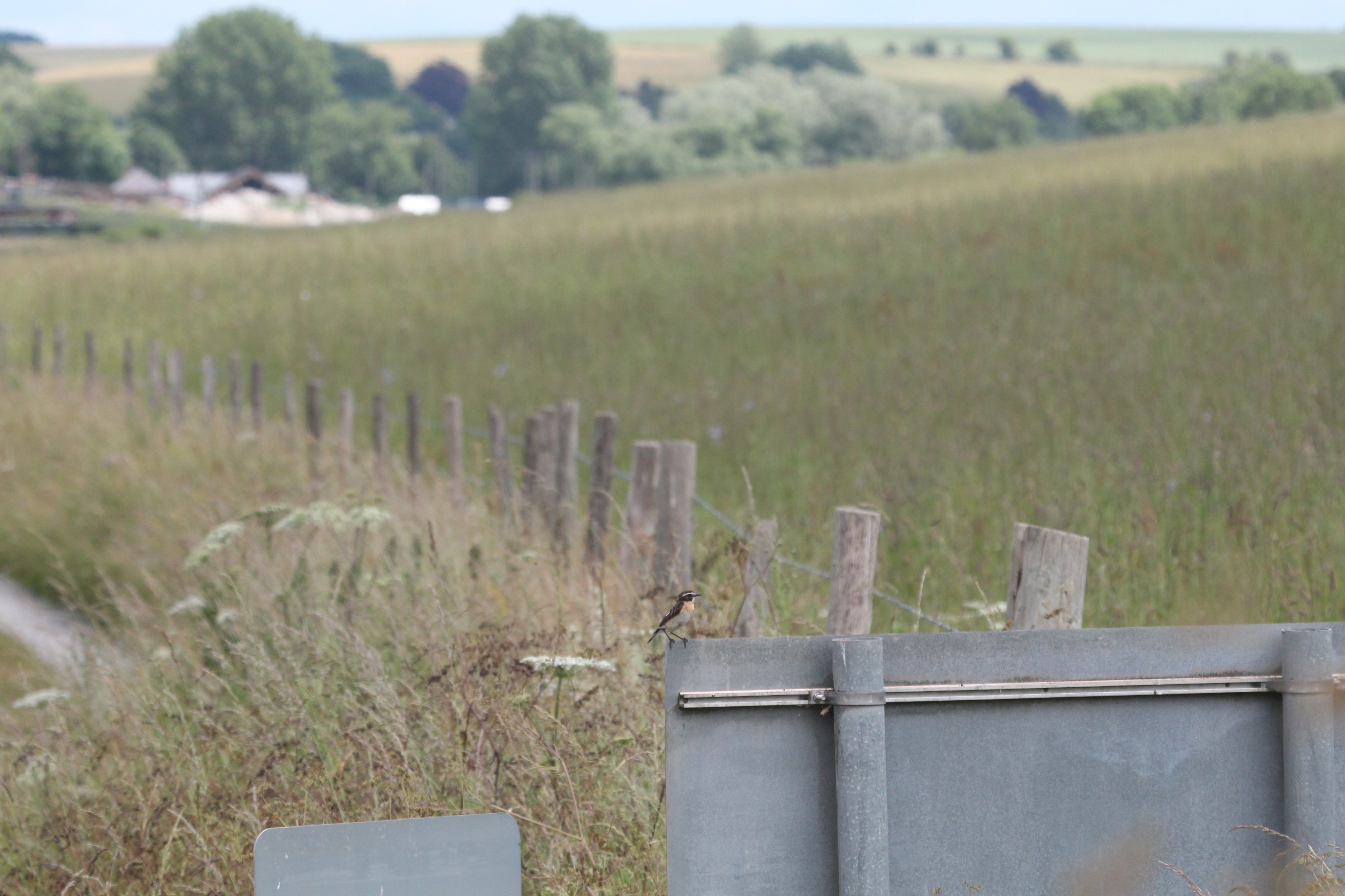
A Whinchat on territory on Salisbury Plain, the last redoubt of this species in lowland England (Alexander Lees).
A recording of Whinchat from the Derbyshire Peak District, this bird’s beautiful mimicry transports the listener to other places on this bird’s life journey by mimicking species which are not present as regional breeders. Macaulay Library recording.
Living in the Peak District one would expect that encounters with Whinchats might be a daily phenomenon, the region is after all synonymous with the suite of ‘upland’ passerines which includes not only this species, but Tree Pipits (Anthus trivialis), Common Redstarts, Northern Wheatears, Pied Flycatchers and Wood Warblers (Phylloscopus sibilatrix). However, Whinchats, and indeed all the above-mentioned species have declined dramatically locally—in my home valley of Longdendale—we have only managed to locate a single singing male Whinchat in 2023. I watched this individual pour forth its beautiful mimetic song—a medley of mimicry included those singing around it on its breeding territory like Willow Warbler and Eurasian Robin, but also Corn Bunting and Grey Partridge (Perdix perdix) which must have been learned elsewhere and with a touch of the Afrotropical thrown-in with Common Bulbul (Pycnonotus barbatus) song phrases clearly recognisable. A decade ago Whinchats were far more widespread locally, and yet unlike the situation in lowland England we still seem to have a vast amount of suitable habitat which is unoccupied. What is going on?
It makes sense to attribute habitat loss as the driver of extinction of Whinchats in the lowlands, especially given that Salisbury Plain has retained the species and the 19th century landscape that suits it. However, declines in the uplands are more difficult to explain given that recent modelling studies suggest that there is ample Whinchat breeding habitat13. Perhaps the problem is in the wintering grounds? We know that Whinchats have weak migratory connectivity—birds from different UK populations winter widely across West Africa14—and we know that the species has very flexible habitat requirements there15 which suggests that declines are unlikely to be due to processes occurring outside the UK. All the data point to poor recruitment stemming from low breeding productivity, but the mechanisms that underpin this remain unclear16 17. As Whinchats have declined locally, congeneric European Stonechats (Saxicola rubicola) are increasingly filling their territories locally. Nationwide, Whinchats have declined by 57% in a quarter of a century whilst in the same period Stonechats have increased by 147%18, a population increase buoyed by mild winters which favour this resident species. It is tempting to assume some causal relationship—and I have watched local Stonechats pursue Whinchats, but the two species co-occur across large swathes of the Palearctic, including in lowland habitat with relatively robust populations like Salisbury Plain. Perhaps upland Whinchats are impacted by within-habitat changes in food availability and a brewing phenological mismatch. Perhaps upland habitats are suboptimal for the species anyway, it is after all only an upland species in the UK because there is nowhere left for it in the lowlands…
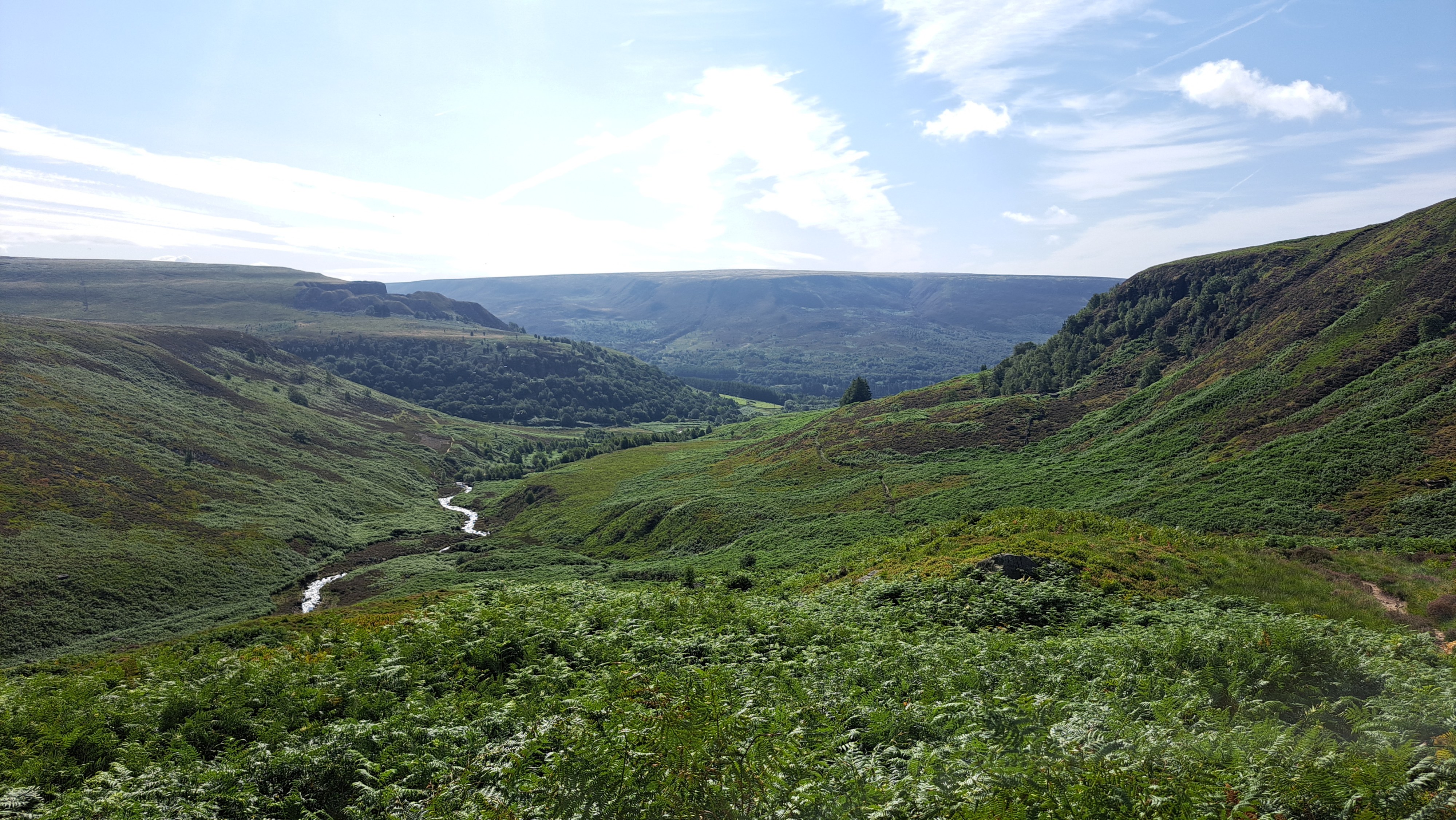
The valley at Crowden in the Derbyshire Peak District, this viewshed formerly hosted breeding Wood Warbler, Tree Pipit, Pied Flycatcher and Common Redstart, but all have been absent in the last few years. A single male Whinchat held territory in 2023 (Alexander Lees)
The other ‘upland’ passerine species that ought to be common locally are also in serious trouble. No Tree Pipits settled in Longdendale this year; only a single Wood Warbler held territory for a week or so; a few pairs of Wheatears and Redstarts cling on; while the two pairs of Pied Flycatchers that held territory this year apparently failed to breed and moved on. Wheatears have likely disappeared with the end of intense overgrazing. This reduction in grazing pressure from sheep and rabbits has probably condemned to local extinction what is really an Alpine-Arctic species which colonised barren degraded landscapes and has disappeared with vegetation succession. For example, Wheatears were formerly abundant in the East Anglian Breckland, but disappeared rapidly when the rabbit population there collapsed following the myxomatosis outbreaks in the early 1950s19. However, for the remaining species we now seemingly have more habitat available than at any recent time. Moreover, all these species, with the exception of Pied Flycatcher, were also widely distributed in the lowlands historically too.
It seems incredible now, but a century ago Whinchat, Wood Warbler, Tree Pipit and Common Redstart were all regular breeders in Epping Forest in Greater London – within what is now the M25 ring-road20. They bred alongside other lost long-distance migrant species like Corncrakes (Crex crex), Red-backed Shrikes (Lanius collurio), Nightingales and Eurasian Nightjars (Caprimulgus europaeus) in a mosaic landscape that has continuously included woodland and heathland since Neolithic times. The habitat has not been lost although it is subject to a raft of stressors from heavy visitor footfall to diffuse nitrogen pollution. This change in species composition is an example of shifting baseline syndrome; it is easily to collectively forget the nature of past ecosystems and assume that current distributional patterns and bioabundance are the norm. No single facet of change can explain the loss of species here, some are associated with early successional habitats, some late successional ones, some are on the northern edge of their range in southern England, some close to the southern edge. Specialist resident woodland species like Marsh (Poecile palustris) and Willow Tits (Poecile montanus) and Lesser Spotted Woodpeckers (Dryobates minor) are all either lost or on the cusp of local extinction there, mirroring declines across southern and eastern England. Meanwhile populations of generalist woodland bird species and some short-distance migrants like Blackcap (Sylvia atricapilla) and Chiffchaff have increased, in several cases likely bolstered by a combination of supplementary feeding and milder winters, potentially shifting the balance of competition with resident specialists and long-distance migrants21. Epping Forest, like much of the UK hosts an increasingly homogenised avifauna, with abundant generalists and few or no specialists left. Intriguingly, Cox et al.22 noted that the exceptional 56 singing male Redstarts in Epping Forest in 1963 followed the severest winter of the 20th century with widespread mortality of resident species and speculated that this might not have been coincidental. Perhaps a combination of a later spring and reduced competition prompted birds to settle further south. At any rate, the causes of declines in both migrants and residents are complex and species-specific, but reflect a broader Anthropocene trend across diverse groups of species with long-distance migration increasingly disfavoured as a strategy23.
One factor however may be acting as a ‘force-multiplier’ on top of a diverse set of decline drivers that may include changes in habitat structure and quality, and concomitant food availability in turn mediated by competition with other species. That factor is a warming climate and the best example of a species responding to this rapid change is the Willow Warbler (Phylloscopus trochilus), until very recently one of the most abundant migratory birds in southern England. The change in status in the species, even over a six-year period in the 2010s has been stark. I lived outside the UK between 2010-2016; returning to take up a lectureship in the UK. Subsequently my first spring visits to my childhood local patches in south Lincolnshire in 2017 were met by a jarring absence of Willow Warbler song, a shock given that the species was abundant in my new home in Longdendale. Since then however I have even noticed declines here in the Peak District; in the six years I have lived here there has been a noticeable drop in abundance at the bottom of the valley, with no birds on territory within 500 m of my house. That said Willow Warbler is still abundant higher up the valley, indeed there are now likely more of them on territory in Longdendale than in the whole county of Essex. A recent modelling study24 indicates that the optimum breeding season temperature for Willow Warbler is 11°C, whilst Chiffchaffs prefer a warmer 13.5°C. This would largely explain why Chiffchaffs have increased by 113% between 1995-2020 in England, whilst Willow Warblers have declined by 48% in the same period5. Further north things are different, Chiffchaffs have increased by a staggering 982% in Scotland, whilst Willow Warblers have increased by a more modest 35%25. This rapid change in status differentiated latitudinally is an obvious signal that changing climate is rapidly reshaping the UK avifauna. As a precedent, the relictual population of Willow Warblers in the mountains of North Spain was lost between the two European Breeding Bird Atlases (1980s and 2013-2017) and the latest Atlas also highlights range contractions elsewhere at the southern range edge26. Willow Warbler will likely disappear from lowland England in decades, they may even eventually be replaced by Western Bonelli’s Warbler (Phylloscopus bonelli) or Iberian Chiffchaff (Phylloscopus ibericus) which has bred extralimitally in south Wales27. Climate change likely underpins the declines in other long-distance forest-associated insectivorous migrants owing to an emerging timing of arrival mismatch with the short spring food peak28. Some support for this also comes from increases in some long-distance migratory species such as Common Reed Warbler (Acrocephalus scirpaceus) which has increased by 105% between 1967-202029, perhaps because wetland habitats offer much more temporally stable food resources – without the temporally tight resource boom we see in forests30. Or perhaps also because we have invested millions in conserving freshwater wetlands.
The implication that changing climates may be a major driver of losses in many of our beloved Afrotropical migrants has many practical implications. For one it is another stick with which to beat denialists with, as the loss of species like Willow Warbler is a very tangible one. It should also be another wake-up call that we need transformative change to mitigate climate change and biodiversity loss31. It also means for northern species that we need to look to safeguard climate refugia for them, facilitate upslope movements and perhaps for some species like Ring Ouzel (Turdus torquatus) in south-west England recognise that we can no longer manage some landscapes for Arctic-Alpine species in a warming world. Of course there is still much that can be done to increase habitat availability for other migrants—as Willow Warbler has disappeared from my old local patches of south-west Lincolnshire so have Turtle Dove, Nightingale and Spotted Flycatcher (Muscicapa striata) all of which are not at the southern range edge, and for which changes in habitat structure and prey abundance might be reversed with the right sorts of environmental policy and incentives for land-owners. Then there is the holy trinity of light, sound and chemical/plastic pollution which may be massively impacting insect bioabundance32, all of which have fixes and some of which are relatively easy to implement. We now know that emergent aquatic invertebrates are crucial resources for many species and the combination of phenological mismatch and declines in river heath might well be a major driver of the loss of aerial insectivores from our skies33.

Red-backed Shrike (Alexander Lees)
It is easy to despair at the scale of the challenges posed by the entwined climate and biodiversity crises but knowing that many of these are driven by species-specific processes for which there are tangible opportunities to reverse declines gives us hope. For example habitat management and restoration has reversed declines in Red-backed Shrikes in Belgium34 35 and increases on the near-continent may make recolonisation of the UK more likely if associated with similar habitat management here. Reversing declines requires action at the flyway scale, not only securing passage and wintering areas but ensuring that populations towards the core of species geographical ranges are booming as downturns there can affect recruitment in locations towards the periphery as the UK is for many species. There is a lot to do and no time to lose.
Photo: Wood warbler (Phylloscopus sibilatrix). © Volker Hesse | Macaulay Library at the Cornell Lab
References
- Axell, H.E. and Pearson, D.J. 1966. The great fall of migrant birds. Transactions of the Suffolk Naturalists Society, 13: 250-266 ↩︎
- Davis, P. 1966. The great immigration of early September 1965. British Birds, 59, 353-374. ↩︎
- Burns, F., Eaton, M.A., Burfield, I.J., Klvaňová, A., Šilarová, E., Staneva, A. and Gregory, R.D. 2021. Abundance decline in the avifauna of the European Union reveals cross‐continental similarities in biodiversity change. Ecology and Evolution, 11, 16647-16660. ↩︎
- Brown, A. and Grice, P. 2005. Birds in England. T. & A.D. Poyser. ↩︎
- Massimino, D., Woodward, I.D., Hammond, M.J., Barber, L., Barimore, C., Harris, S.J., Leech, D.I., Noble, D.G., Walker, R.H., Baillie, S.R. & Robinson, R.A. 2023. BirdTrends 2022: trends in numbers, breeding success and survival for UK breeding birds. Research Report 753. BTO, Thetford. www.bto.org/birdtrends. ↩︎
- De Vries, E.H.J., Foppen, R.P., Van Der Jeugd, H. and Jongejans, E., 2022. Searching for the causes of decline in the Dutch population of European Turtle Doves (Streptopelia turtur). Ibis, 164, 552-573. ↩︎
- Browne, S.J. and Aebischer, N.J., 2004. Temporal changes in the breeding ecology of European Turtle Doves Streptopelia turtur in Britain, and implications for conservation. Ibis, 146, 125-137. ↩︎
- Stockdale, J.E., Dunn, J.C., Goodman, S.J., Morris, A.J., Sheehan, D.K., Grice, P.V. and Hamer, K.C. 2015. The protozoan parasite Trichomonas gallinae causes adult and nestling mortality in a declining population of European Turtle Doves, Streptopelia turtur. Parasitology, 142, 490-498. ↩︎
- Massimino, D., Woodward, I.D., Hammond, M.J., Barber, L., Barimore, C., Harris, S.J., Leech, D.I., Noble, D.G., Walker, R.H., Baillie, S.R. & Robinson, R.A. 2023. BirdTrends 2022: trends in numbers, breeding success and survival for UK breeding birds. Research Report 753. BTO, Thetford. www.bto.org/birdtrends. ↩︎
- Blathwayt, F.L. 1915. The Birds of Lincolnshire. Lincolnshire Naturalists’ Union Transactions 3: 178-211. ↩︎
- Sharrock, J.T.R. 1976. The atlas of breeding birds in Britain and Ireland. Berkhamsted, UK: T. & A. D. Poyser. ↩︎
- Balmer, D.E., Gillings, S., Caffrey, B.J., Swann, R.L., Downie, I.S., and Fuller, R.J. 2013. Bird atlas 2007–11: The breeding and wintering birds of Britain and Ireland. Thetford, UK: British Trust for Ornithology. ↩︎
- Stanbury, A.J., Tománková, I., Teuten, E.L. and Douglas, D.J. 2022. No evidence that declining Whinchat Saxicola rubetra are currently limited by the availability of apparently suitable breeding habitat within the UK uplands. Journal of Ornithology, 163, 273-283. ↩︎
- Burgess, M.D., Finch, T., Border, J.A., Castello, J., Conway, G., Ketcher, M., Lawrence, M., Orsman, C.J., Mateos, J., Proud, A. and Westerberg, S. 2020. Weak migratory connectivity, loop migration and multiple non‐breeding site use in British breeding whinchats Saxicola rubetra. Ibis, 162, 1292-1302. ↩︎
- Blackburn, E. and Cresswell, W. 2015. Fine‐scale habitat use during the non‐breeding season suggests that winter habitat does not limit breeding populations of a declining long‐distance Palearctic migrant. Journal of Avian Biology, 46, 622-633. ↩︎
- Stanbury, A.J., Tománková, I., Teuten, E.L. and Douglas, D.J. 2022. No evidence that declining Whinchat Saxicola rubetra are currently limited by the availability of apparently suitable breeding habitat within the UK uplands. Journal of Ornithology, 163, 273-283. ↩︎
- Fay, R., Schaub, M., Banik, M.V., Border, J.A., Henderson, I.G., Fahl, G., Feulner, J., Horch, P., Korner, F., Müller, M. and Michel, V. 2021. Whinchat survival estimates across Europe: can excessive adult mortality explain population declines? Animal Conservation, 24, 15-25. ↩︎
- Massimino, D., Woodward, I.D., Hammond, M.J., Barber, L., Barimore, C., Harris, S.J., Leech, D.I., Noble, D.G., Walker, R.H., Baillie, S.R. & Robinson, R.A. (2023) BirdTrends 2022: trends in numbers, breeding success and survival for UK breeding birds. Research Report 753. BTO, Thetford. www.bto.org/birdtrends. ↩︎
- Brown, A. and Grice, P. 2005. Birds in England. T. & A.D. Poyser. ↩︎
- Buxton, E.N. 1923. Epping Forest. Edward Stanford, London W.C. ↩︎
- Shutt, J.D. and Lees, A.C. 2021. Killing with kindness: Does widespread generalised provisioning of wildlife help or hinder biodiversity conservation efforts? Biological Conservation, 261, 109295. ↩︎
- Cox, S. 1984. A New Guide to the Birds of Essex. Essex Birdwatching and Preservation Society, Essex ↩︎
- Lees, A.C., Haskell, L., Allinson, T., Bezeng, S.B., Burfield, I.J., Renjifo, L.M., Rosenberg, K.V., Viswanathan, A. and Butchart, S.H. 2022. State of the world’s birds. Annual Review of Environment and Resources, 47, 231-260. ↩︎
- Martay, B., Pearce‐Higgins, J.W., Harris, S.J. and Gillings, S. 2023. Breeding ground temperature rises, more than habitat change, are associated with spatially variable population trends in two species of migratory bird. Ibis, 165, 34-54. ↩︎
- Massimino, D., Woodward, I.D., Hammond, M.J., Barber, L., Barimore, C., Harris, S.J., Leech, D.I., Noble, D.G., Walker, R.H., Baillie, S.R. & Robinson, R.A. 2023. BirdTrends 2022: trends in numbers, breeding success and survival for UK breeding birds. Research Report 753. BTO, Thetford. www.bto.org/birdtrends. ↩︎
- Keller, V., Herrando, S., Voríšek, P., Franch, M., Kipson, M., Milanesi, P., Martí, D., Anton, M., Klvanová, A., Kalyakin, M.V. and Bauer, H.G. 2020. European breeding bird atlas 2: distribution, abundance and change. European Bird Census Council & Lynx Edicions. ↩︎
- Hunter, E. 2018. Iberian Chiffchaff: a new breeding species for Great Britain. British Birds, 111, 100-108. ↩︎
- Both, C., Van Turnhout, C.A., Bijlsma, R.G., Siepel, H., Van Strien, A.J. and Foppen, R.P. 2010. Avian population consequences of climate change are most severe for long-distance migrants in seasonal habitats. Proceedings of the Royal Society B: Biological Sciences, 277, 1259-1266. ↩︎
- Massimino, D., Woodward, I.D., Hammond, M.J., Barber, L., Barimore, C., Harris, S.J., Leech, D.I., Noble, D.G., Walker, R.H., Baillie, S.R. & Robinson, R.A. 2023. BirdTrends 2022: trends in numbers, breeding success and survival for UK breeding birds. Research Report 753. BTO, Thetford. www.bto.org/birdtrends. ↩︎
- Both, C., Van Turnhout, C.A., Bijlsma, R.G., Siepel, H., Van Strien, A.J. and Foppen, R.P. 2010. Avian population consequences of climate change are most severe for long-distance migrants in seasonal habitats. Proceedings of the Royal Society B: Biological Sciences, 277, 1259-1266. ↩︎
- Díaz, S., Settele, J., Brondízio, E.S., Ngo, H.T., Agard, J., Arneth, A., Balvanera, P., Brauman, K.A., Butchart, S.H.M., Chan, K.M.A., Garibaldi, L.A., Ichii, K., Liu, J., Subramanian, S.M., Midgley, G.F., Miloslavich, P., Molnár, Z., Obura, D., Pfaff, A.,Polasky, S., Purvis, A., Razzaque, J., Reyers, B., Chowdhury, R.R., Shin, Y-J., Visseren-Hamakers, I., Willis, K.J. and Zayas, C.N. 2019. Pervasive human-driven decline of life on Earth points to the need for transformative change. Science, 366, p.eaax3100. ↩︎
- Wagner, D.L. 2020. Insect declines in the Anthropocene. Annual Review of Entomology, 65, 457-480. ↩︎
- Shipley, J.R., Twining, C.W., Mathieu-Resuge, M., Parmar, T.P., Kainz, M., Martin-Creuzburg, D., Weber, C., Winkler, D.W., Graham, C.H. and Matthews, B. 2022. Climate change shifts the timing of nutritional flux from aquatic insects. Current Biology, 32, 1342-1349. ↩︎
- NijsHet, G. 2020. Het landschap als legpuzzel: onderzoek naar de ecologie van de Grauwe Klauwier in Vlaams-Brabant. Natuur.oriolus 86, 127-139. ↩︎
- Paquet, J.-Y., De Broyer, A., Laudelout, A., Cavelier, D., Lighezzolo, P., Kints, O. & Goret, T. 2020. Augmentation remarquable de la population de Pie-grièche écorcheur Lanius collurio dans les sites Natura 2000 de Fagne-Famenne (Belgique). Aves, 57, 27-40. ↩︎
Photo: Wood warbler (Phylloscopus sibilatrix). © Volker Hesse | Macaulay Library at the Cornell Lab
 Tales from the flyway