By Angela Turner
When I lived in East Sussex in southern England in the early 1990s, one of my favourite birding things to do at spring and autumn migration time was to go to the south coast between Beachy Head and Cuckmere Haven. The patches of scrub and grassland along the imposing white cliffs, together with the small Horseshoe Plantation, were ideal for finding newly arrived birds such as Ring Ouzels and Common Redstarts, among many other species. An early morning walk in spring was usually a rewarding start to the day. This was most enjoyable when my favourite birds, Barn Swallows and House and Sand Martins, swooped over the cliffs in spring. If no one else was around to hear, I’d call out welcome back! It wasn’t the end of their migration of course but they’d survived the long flight from Africa and had a relatively short way to go from the coast to their breeding sites. In autumn, I looked for warblers feeding on berries and flitting among the vegetation, and I watched hirundines go overhead in flocks of hundreds of individuals, vanishing in the distance over the sea on their journey south. I would wave them goodbye, sad to lose their cheery, companiable twittering and elegant aerobatics as another winter drew near.
In the 1970s, before moving south myself, I lived in Scotland, first on the east coast near Stirling to do my doctoral research on the feeding and breeding behaviour of Swallows and Sand Martins, then in Glasgow on the west coast. So, I had to wait for them to wend their way across England before welcoming them back each spring. In winter, as well as analysing data from my research, I spent much of my time looking at Swallow and Sand Martin faeces to identify, from their undigested wings, the type of insects they had eaten, such as blow flies, horse flies and hover flies, mayflies and aphids. As soon as spring approached though, I would excitedly check their potential nesting sites on the local farms and villages each day around their expected arrival date. It was always a pleasure and a relief to hear the first babbling songs. They’d made it back! Summer was always busy for me with ringing Swallows and Sand Martins, recording their diet and behaviour, and just enjoying watching the adults skimming over the fields and seeing the chicks grow and fledge. It seemed all too soon that adults and fledglings were lined up on telegraph wires, restless and ready to depart. I live near Nottingham in the East Midlands now and I still welcome back the Swallows and martins in spring and bid them farewell in autumn. However, the expected dates have changed. Because of climate change I can now expect the first Swallows to appear about three weeks earlier than in the 1970s and I might see Sand Martins nearly a month earlier1.
Since at least the time of the Ancient Greeks, the Swallow has been the harbinger of spring, a sign of the end of harsh winter weather. In Europe, Swallows were once particularly associated with Christian beliefs and were said to return in time to celebrate Easter and Christ’s Resurrection. Their arrival was often associated with certain saints’ days or religious festivals such as St Benedict’s Day (21st March) in Italy and the Feast of the Annunciation (25th March) in France and Russia. Such traditions, however, are now out of synch with the advance of spring in recent years brought about by climate change.
In autumn, too, climate change is altering the timing of the seasons and the behaviour of migrants. Swallows are staying later, even sometimes being seen in winter months. Most Swallows have left England by the end of October, a few late individuals hanging on into November. December sightings of Swallows are rarer, though they go back to at least the nineteenth century, and these are mostly in mild, coastal areas. By January, if they have not left on their migration, such birds have usually perished from the cold and scarcity of insects to eat, but occasionally one survives longer. In January 2009 one Swallow, which came to be known as Rambo because of its apparent toughness, lived through temperatures as low as –12oC in an RSPB reserve, Marazion Marsh, near Penzance in Cornwall.2 And that’s not the first time Swallows have chosen Cornwall as their winter home. There have been many early winter records of their presence, while in January 1975 three first-year birds stayed in the same area near Penzance, with one undergoing a partial moult into adult plumage and persisting to at least the end of February.
The main obstacle to Swallows overwintering here is the near absence of the aerial insects on which they depend, together with the short period of daylight in which to feed. Only a few insects, such as winter moths and swarming winter gnats, are active in winter. Even if it is too cold for most insects to fly, however, Swallows can utilise alternative sources of food, for example by perching and picking up insects and spiders from the ground, vegetation or walls of buildings. In Africa, Swallows have been seen taking insects from vegetation while hovering, and catching sand hoppers, tiny crustaceans, on the shoreline. Similarly, Swallows overwintering in Cornwall were seen foraging for invertebrates in seaweed on the beach. Sewage farms can also be good sources of insects for Swallows in cold weather. Surprisingly, there are records of Swallows wintering in South Africa eating some plant food, the fleshy seeds of the coastal wattle (Acacia cyclops), and of House Martins consuming berries 3. Whether Swallows in the UK could follow suit is not known.
Ironically, people used to believe that Swallows did stay in England and elsewhere in Northern Europe over winter but in a torpid state buried in the mud at the bottom of ponds and lakes, or hidden in crevices in trees and buildings, only to emerge in spring. Some people found it difficult to believe such a small bird could fly such long distances to warmer localities and then return in spring. While evidence for migration grew in the eighteenth and nineteenth centuries, it was not until the early twentieth century that their winter home was found, when a Swallow ringed in Cheadle, in Staffordshire, in May 1911 turned up on a farm in KwaZulu-Natal, South Africa, on 23rd December 1912. Further ringing recoveries showed they mostly wintered over a wide area of southern Africa, including Namibia, Botswana and South Africa.
Swallows from the UK take six weeks for this 10 000-kilometre journey, including having to cross the Sahara Desert. Then in the spring they must make the trip back. Many Swallows don’t survive it. Despite the risks, however, it is worth the effort. In winter in the UK, it would be difficult for Swallows to find enough insects in the few daylight hours available for foraging, whereas in southern Africa, it is warmer at that time of year, insects are plentiful and the days longer. In contrast, in the spring and summer the abundance of food and long daylight hours have made our shores an ideal place for them to breed.
Records of Swallows in winter months in the UK have been increasing, however, particularly in the milder southwest of England and south Wales, as well as Ireland, where insects are more likely to be available, and an extraordinary twelve Swallows stayed for the 2021/2022 winter4. This trend is likely to be because our winters are getting milder, thanks to climate change. The Met Office predicts UK winters will be between 1°C and 4.5°C warmer in 2070 than in 1990, as well as 30% wetter5. By the end of the twenty-first century, much of the UK could see an end to below-zero temperatures and snow cover. With less risk of extreme cold, conditions could become more suitable for insects to be active and for Swallows to overwinter here, instead of facing the perils of migration. Such individuals would also benefit from being able to find a nest site and a mate earlier than migratory ones, potentially increasing their breeding success.
Winters are still variable, however, and the weather sometimes too extreme for Swallows to survive, such as the long spell of low temperatures and snow in December 2022. Overwintering or early arriving Swallows are also at risk from extreme cold weather in late February and March, as happened in 2018 when Anticyclone Hartmut, dubbed ‘The Beast from the East’, swept over large areas of the country bringing deep snow and subzero temperatures.
Overwintering in the UK with its changeable weather is clearly not yet a viable alternative to migrating for Swallows but could be a possibility in future given current climate trends. I wonder how I would feel about regularly seeing Swallows in winter. Given my age, I may not be around by then, but if I were I think I would miss the anticipation, the pleasure of hearing the first twittering song, seeing the first flash of blue, and most of all I would miss the arrival of these birds marking the transformation of winter into spring.
Dr Angela Turner is author of The Barn Swallow.
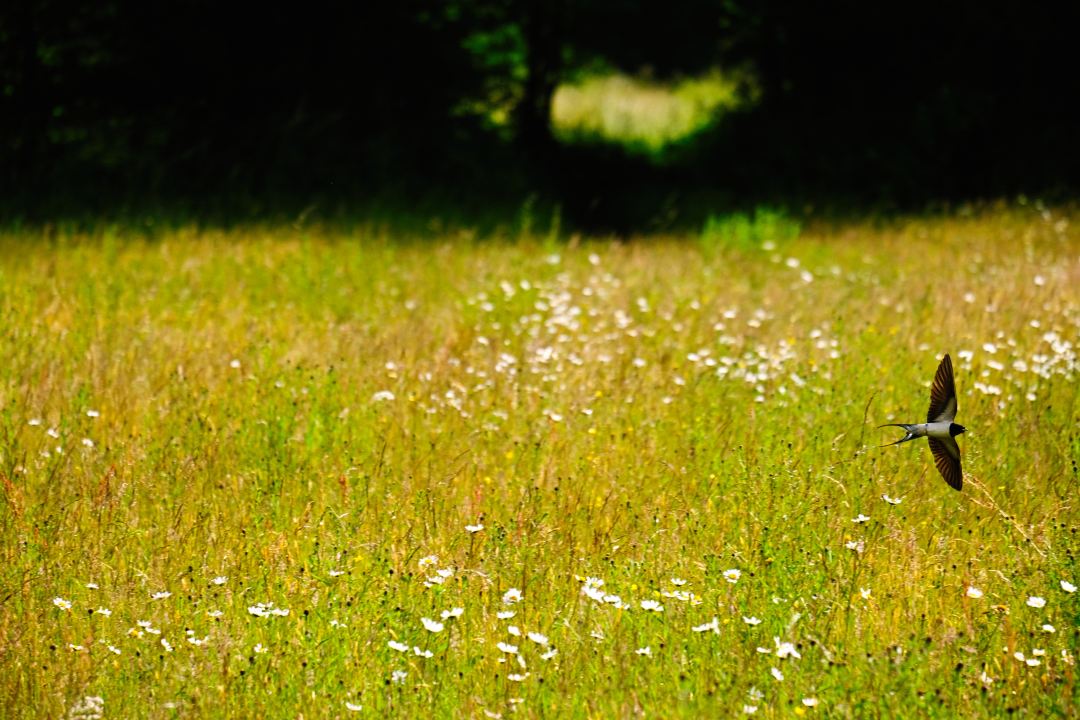
Photo: Barn swallow (Hirundo rustica). Author: Kevin Grieve.
- https://www.bto.org/sites/default/files/u37/downloads/about_birdtrack/BTO_294pg12-14.pdf ↩︎
- https://www.dailymail.co.uk/sciencetech/article-1115442/Meet-Rambo–tough-little-swallow-forgot-fly-South-winter.html ↩︎
- https://www.thetimes.co.uk/article/feather-report-house-martins-blue-tits-jays-and-magpies-sf962nl9rjf ↩︎
- https://www.bto.org/about-bto/press-releases/swallows-have-started-spending-winter-britain-instead-migrating-6000-miles ↩︎
- https://www.metoffice.gov.uk/weather/climate-change/climate-change-in-the-uk ↩︎
 Tales from the flyway